
Most businesses in developing markets don’t fail suddenly. They slow down gradually. Growth becomes inconsistent, operations become messy, and decisions become reactive instead of planned.
From the outside, it often looks like “market conditions” are the problem. But inside the business, the real issues are usually structural.
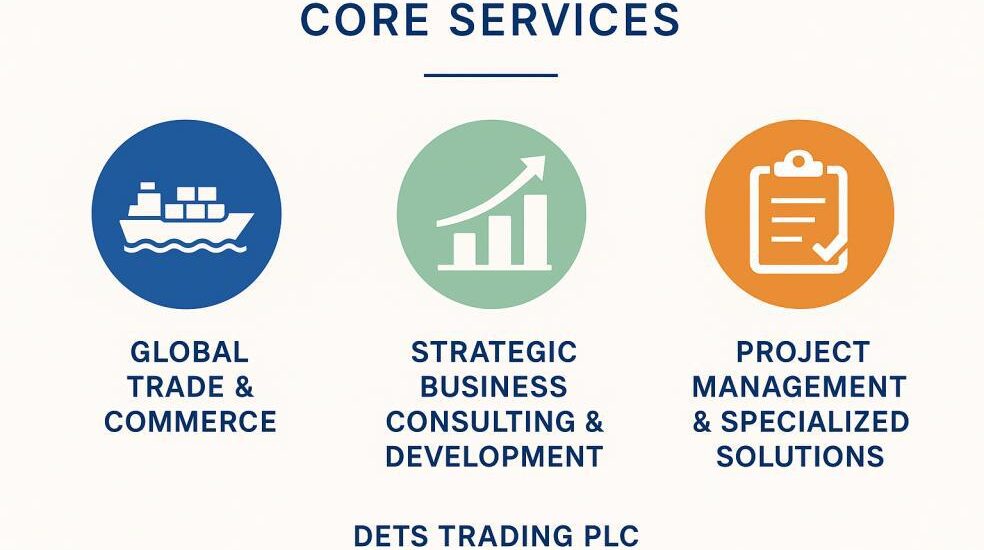
DETS Trading PLC works in environments where these challenges are common, especially across trade, consulting, and project-based operations.
1. Weak internal systems
One of the biggest hidden problems is the absence of clear systems.
Many businesses rely on:
- verbal instructions
- informal processes
- individual memory
- experience-based decisions
This works at a small scale. But as the business grows, it creates confusion.
Without systems:
- tasks get repeated incorrectly
- responsibility becomes unclear
- performance becomes inconsistent
2. Overdependence on individuals
In many organizations, everything depends on a few key people.
When those individuals are:
- busy
- absent
- or overloaded
the entire system slows down.
This creates a fragile structure where:
- knowledge is not documented
- skills are not transferred
- operations cannot scale easily
Strong businesses are built on systems, not personalities.
3. Poor execution discipline
Many companies have plans, but struggle with execution.
Common issues include:
- delayed implementation
- incomplete follow-through
- shifting priorities
- lack of accountability
The gap between planning and execution is often where growth breaks down.
4. Weak communication structure
Communication problems are often underestimated.
Typical signs:
- unclear instructions
- missing updates
- delayed responses
- assumptions instead of clarity
When communication is not structured, small misunderstandings turn into big operational problems.
5. No performance measurement
Many businesses operate without clear measurement systems.
This leads to:
- unclear success criteria
- difficulty identifying problems
- decisions based on intuition only
Without measurement, improvement becomes guesswork instead of a process.
6. Reactive decision-making
Instead of planning ahead, many businesses react to problems as they appear.
This results in:
- constant firefighting
- short-term thinking
- lack of strategic direction
Reactive systems keep businesses busy, but not necessarily growing.
7. Limited process documentation
When processes are not written down:
- training becomes difficult
- consistency is lost
- scaling becomes slow
Documentation is often ignored, but it is one of the foundations of long-term growth.
Why these problems are so common
These challenges are not unique to one company or one country. They are common in developing markets because:
- businesses grow faster than their systems
- formal processes are not prioritized early
- focus is often on output, not structure
- experience is valued more than documentation
The result is growth without stability.
What changes everything
The turning point for most businesses is not more effort. It is structure.
When a business introduces:
- clear systems
- defined roles
- documented processes
- performance tracking
- consistent communication
everything becomes easier to manage and scale.
Final thought
Most growth problems are not caused by lack of opportunity.
They are caused by weak internal structure.
Businesses that recognize this early stop trying to “work harder” and start building systems that allow them to grow without chaos.